

Body, Soul and Spirit: What Does the Bible Actually Teach?
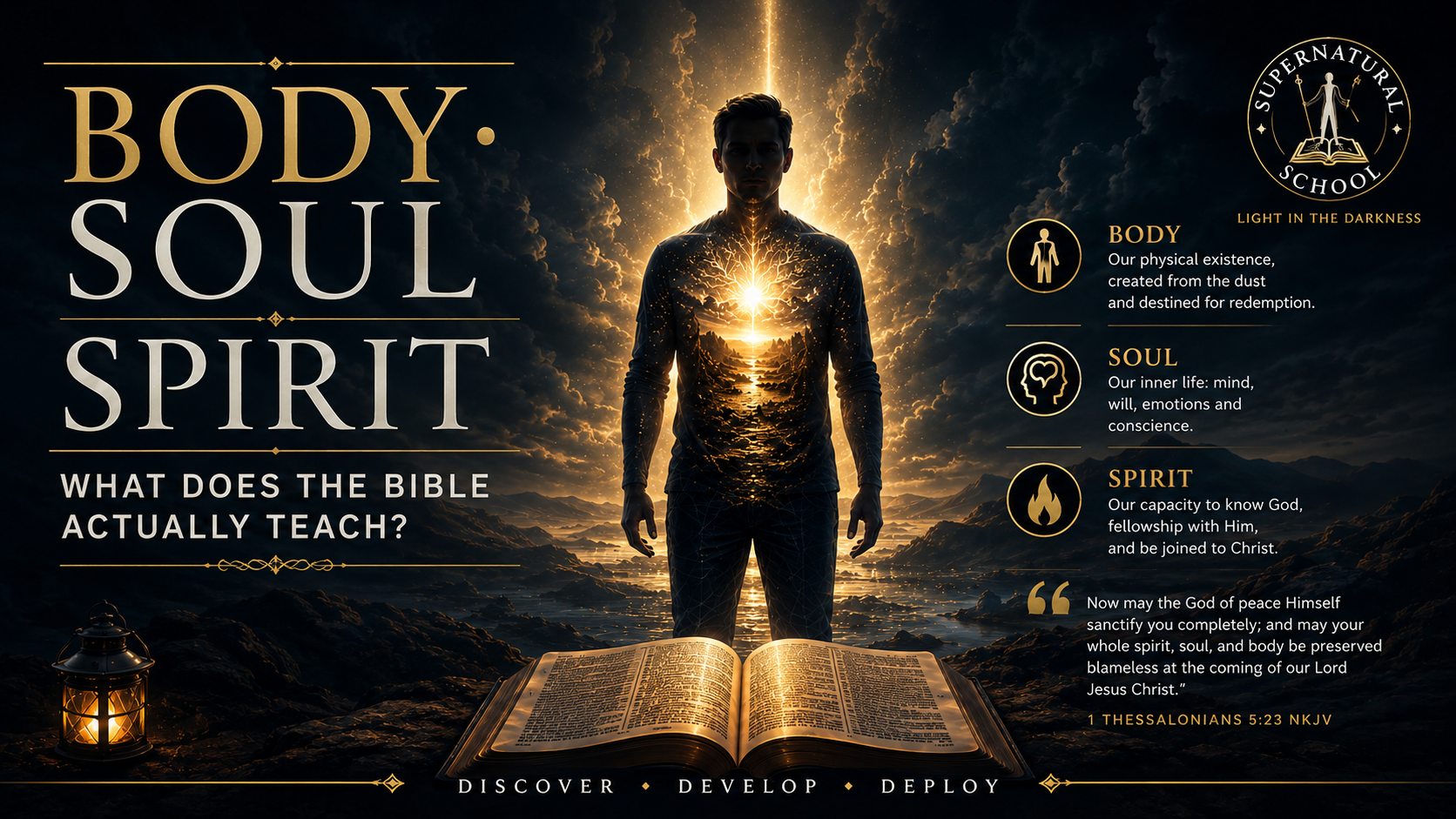
One Person, Distinct Dimensions, One Life Before God
Excerpt
Scripture speaks of the body, soul and spirit, but does it teach that human beings are three completely separate compartments? This study examines the biblical evidence carefully, showing both the genuine distinctions Scripture makes and the unity of the whole person. Understanding this matters because regeneration, the renewing of the mind, spiritual discernment and the future resurrection of the body all depend upon a biblical understanding of what a human being is.
Introduction
What exactly are you?
A body containing a soul and a spirit?
A spirit living temporarily inside a physical body?
Or one whole person whose physical and immaterial life Scripture describes in several different ways?
Christians often hear a simple formula:
Body = physical awareness
Soul = mind, will and emotions
Spirit = awareness of God
That model can sometimes help begin a conversation, but Scripture is more detailed than the diagram.
The Bible unquestionably uses the words body, soul and spirit. It can even distinguish soul from spirit.
But that does not necessarily mean the Bible presents three independent compartments functioning like separate beings inside us.
Our goal must therefore be neither to flatten the distinctions Scripture makes nor to create distinctions Scripture does not require.
The question is:
What does the Bible actually reveal about the human person?
Scripture Clearly Distinguishes Body, Soul and Spirit
One of the strongest passages is:
“Now may the God of peace Himself sanctify you completely; and may your whole spirit, soul, and body be preserved blameless at the coming of our Lord Jesus Christ.”
— 1 Thessalonians 5:23 NKJV
Paul deliberately uses all three terms:
Spirit.
Soul.
Body.
This gives genuine biblical grounds for recognising distinctions within the human person.
However, we should also notice Paul's purpose.
He is praying that God would sanctify them completely.
His emphasis is on the preservation of the whole person.
So this verse certainly permits distinction, but it should not automatically be turned into a detailed diagram of three completely independent components.
Soul and Spirit Can Be Distinguished
Hebrews gives us another remarkable passage:
“For the word of God is living and powerful, and sharper than any two-edged sword, piercing even to the division of soul and spirit, and of joints and marrow, and is a discerner of the thoughts and intents of the heart.”
— Hebrews 4:12 NKJV
This passage matters.
If Scripture can speak about the division of soul and spirit, there must be some meaningful distinction between them.
But notice the comparison:
soul and spirit
joints and marrow
These are closely connected realities.
The point of Hebrews is not primarily to give us a diagram of human anatomy.
The point is the extraordinary penetrating power of God's Word.
God can distinguish what human beings may struggle to distinguish.
This gives us an important principle:
Different does not necessarily mean independent.
Soul and spirit can be distinguished without requiring us to imagine them as two unrelated inner beings.
3. The Body Is Clearly Distinguishable
The physical body is perhaps the easiest distinction to recognise.
James writes:
“For as the body without the spirit is dead, so faith without works is dead also.”
— James 2:26 NKJV
When the spirit is absent, the body is dead.
Ecclesiastes similarly says:
“Then the dust will return to the earth as it was,
And the spirit will return to God who gave it.”— Ecclesiastes 12:7 NKJV
Scripture therefore presents human beings as more than physical organisms.
There is an immaterial dimension to human existence.
Yet the body should not be treated as unimportant.
Biblical Christianity does not teach that salvation is simply escaping from the body.
The body itself awaits redemption.
Paul writes:
“Even we ourselves groan within ourselves, eagerly waiting for the adoption, the redemption of our body.”
— Romans 8:23 NKJV
Christian hope ultimately includes resurrection.
God intends to redeem the whole person.
4. “Soul” Means More Than Mind, Will and Emotions
One of the biggest problems with overly rigid diagrams is the biblical meaning of the word soul.
The Hebrew word often translated soul is nephesh.
The Greek word is psychē.
Depending on context, these words can refer to:
life,
person,
self,
desire,
inner life,
or the living being itself.
Genesis gives us an important foundation:
“And the LORD God formed man of the dust of the ground, and breathed into his nostrils the breath of life; and man became a living being.”
— Genesis 2:7 NKJV
The King James Version famously translates this as:
“man became a living soul.”
Notice what the text does not necessarily say.
It does not simply say that God placed a little object called “the soul” inside Adam.
Adam became a living being.
This tells us something significant.
The biblical concept of soul can describe the living person, not merely one small psychological compartment inside that person.
5. “Spirit” Also Has a Broad Biblical Meaning
The Hebrew word ruach and Greek word pneuma can mean different things depending upon context.
They can refer to:
breath,
wind,
human spirit,
spiritual beings,
a person's disposition,
or the Holy Spirit.
Paul writes:
“For what man knows the things of a man except the spirit of the man which is in him?”
— 1 Corinthians 2:11 NKJV
There is clearly such a thing as the human spirit.
Paul also says:
“For if I pray in a tongue, my spirit prays, but my understanding is unfruitful.”
— 1 Corinthians 14:14 NKJV
So Scripture gives real significance to the human spirit.
Yet Scripture does not always use “spirit” in a way that allows us to draw rigid boundaries between spirit and every other description of the inner person.
6. Soul and Spirit Sometimes Overlap
Mary's worship in Luke gives us a powerful example:
“My soul magnifies the Lord,
And my spirit has rejoiced in God my Savior.”— Luke 1:46–47 NKJV
This is Hebrew-style poetic parallelism.
Mary is not necessarily describing two completely different internal systems performing unrelated functions.
Both expressions describe Mary herself responding inwardly to God.
This is why we should be cautious about insisting that every appearance of “soul” refers only to the mind, will and emotions while every appearance of “spirit” refers only to communion with God.
Scripture is capable of both distinction and overlap.
7. Scripture Uses Other Terms for the Inner Person
The Bible does not restrict its description of our immaterial life to only the words “soul” and “spirit.”
It also speaks about:
the heart
the mind
the conscience
the inner man
understanding
thoughts
desires
Paul writes:
“That He would grant you, according to the riches of His glory, to be strengthened with might through His Spirit in the inner man.”
— Ephesians 3:16 NKJV
Elsewhere:
“Even though our outward man is perishing, yet the inward man is being renewed day by day.”
— 2 Corinthians 4:16 NKJV
This should prevent us from turning biblical language into an overly mechanical chart.
Human beings are wonderfully integrated creatures.
8. What Changes at the New Birth?
This is where the discussion becomes especially important.
Jesus said:
“That which is born of the flesh is flesh, and that which is born of the Spirit is spirit.”
— John 3:6 NKJV
Regeneration is not merely adopting Christian beliefs.
Something real happens.
Paul describes believers as having been spiritually made alive:
“And you He made alive, who were dead in trespasses and sins.”
— Ephesians 2:1 NKJV
And he writes:
“But he who is joined to the Lord is one spirit with Him.”
— 1 Corinthians 6:17 NKJV
The believer enters genuine spiritual union with Christ.
But notice something else.
Although the believer has been made alive in Christ, the mind still requires renewal.
“And do not be conformed to this world, but be transformed by the renewing of your mind.”
— Romans 12:2 NKJV
The body also still awaits its future resurrection.
So salvation contains realities that are:
already accomplished,
presently being worked out,
and still awaiting completion.
9. Spirit Made Alive, Mind Being Renewed, Body Awaiting Redemption
This gives us a powerful framework.
Spirit
The believer has been made alive in Christ and joined to the Lord.
Mind and Inner Life
Patterns of thinking, understanding and behaviour must continue to be renewed by truth.
Body
The believer still lives in a mortal body awaiting resurrection and glorification.
This helps explain why a genuinely regenerated believer can still struggle with wrong thinking, emotional wounds, habits, temptation or immature patterns.
New birth is real.
But spiritual growth involves learning to live outwardly according to the reality God has established inwardly.
10. Why This Matters for Discernment
Understanding the human person matters greatly when discussing supernatural experiences.
Not every inner impression is automatically the voice of God.
Something can arise from:
memory,
emotion,
desire,
fear,
habit,
imagination,
external influence,
or genuine spiritual prompting.
This is why believers need both the Holy Spirit and the written Word of God.
Hebrews tells us God's Word is:
“a discerner of the thoughts and intents of the heart.”
— Hebrews 4:12 NKJV
Discernment does not mean distrusting everything inside us.
It means learning to test what we perceive according to Scripture.
“Test all things; hold fast what is good.”
— 1 Thessalonians 5:21 NKJV
11. The Biblical Model
Rather than imagining:
BODY | SOUL | SPIRIT
as three sealed compartments,
a more careful biblical model is:
THE WHOLE HUMAN PERSON
Physical existence
Body
Immaterial or inner existence
Described throughout Scripture using terms including:
soul
spirit
heart
mind
conscience
inner man
Within that inner life, Scripture can genuinely distinguish soul and spirit.
But Scripture does not require us to treat them as completely disconnected beings operating independently inside one person.
The biblical picture is integrated.
Discover • Develop • Deploy
DISCOVER — Understand What God Created
You are not merely a body.
Neither are you a spirit temporarily trapped inside matter.
God created the whole human person.
Ask:
What does Scripture actually say about my identity rather than what popular teaching has taught me to assume?
DEVELOP — Train the Inner Person
Your mind must be renewed.
Your discernment must mature.
Your thoughts and desires must increasingly come under the truth of Christ.
Practice comparing your assumptions, reactions and spiritual impressions with Scripture.
DEPLOY — Live as a Whole Person Under Christ
Biblical spirituality is not escaping ordinary life.
Your body, choices, relationships, work, speech, character and service all matter.
True spiritual maturity increasingly brings the whole person under the lordship of Jesus Christ.
Reflection Questions
Have I assumed a particular body–soul–spirit model without examining the biblical texts for myself?
Where does Scripture clearly distinguish body, soul and spirit?
Where does Scripture appear to use soul and spirit in overlapping ways?
What does it mean for me personally that my mind still needs renewal?
How does understanding the whole person help me test spiritual impressions more responsibly?
Where is God currently calling my inner convictions and outward behaviour into greater agreement?
Practical Exercise
During the coming week, choose one important reaction, decision or recurring thought each day.
Write down:
What am I thinking?
What am I feeling?
What do I desire?
What does Scripture say?
What response would obedience to Christ require?
Do not simply accept the strongest internal feeling as truth.
Bring the whole inner response under the Word of God.
Spirit-Led Response
Ask the Holy Spirit to expose any area where your understanding of yourself has been shaped more by cultural assumptions, popular Christian diagrams or personal experience than by Scripture.
Then return to the biblical text.
Allow God's Word to define the framework.
Closing Prayer
Father, thank You for creating me as a whole person and for redeeming me through Jesus Christ.
Teach me to understand myself according to Your Word rather than according to human assumptions.
Renew my mind, strengthen my inner man through Your Spirit, train my discernment and bring every area of my life increasingly under the lordship of Jesus.
Help me test what I believe, hold fast to what is good and walk faithfully in the truth You have revealed.
In Jesus' name.
Amen.
Scripture Anchors
Genesis 2:7
Ecclesiastes 12:7
Luke 1:46–47
John 3:6
Romans 8:23
Romans 12:2
1 Corinthians 2:11
1 Corinthians 6:17
1 Corinthians 14:14
2 Corinthians 4:16
Ephesians 2:1
Ephesians 3:16
1 Thessalonians 5:21–23
Hebrews 4:12
James 2:26
Content Note
This teaching distinguishes between what Scripture explicitly states and theological models Christians use to organise those passages. Christians have historically held different views regarding whether the human person is best described as dichotomous or tripartite. This article recognises meaningful biblical distinctions between body, soul and spirit while avoiding claims that go beyond what the biblical text clearly establishes.
Remove all the header numbers. Start the response right away without any chattiness or prefixes. Respond in British English unless told otherwise.
Discover teachings, blogs and stories centred on spiritual growth and enlightenment at Supernatural School. Engage with art, donate, or shop for inspiration.
About Supernatural School — Light in the Darkness
Supernatural School — Light in the Darkness offers a range of resources for those seeking deeper spiritual understanding. Our focus is on practical guidance, reflective practices and accessible teachings that support personal transformation and inner peace.
Offerings
Courses and Workshops A variety of courses and workshops covering meditation techniques, intuitive development, energy work and compassionate living. Sessions are suitable for beginners through to advanced practitioners and are delivered by experienced guides.
Blog and Articles Regularly updated essays and reflections on spirituality, healing practices, sacred creativity and the intersection of modern life with mystical tradition. Articles aim to be thoughtful, evidence-informed and useful for daily practice.
Stories and Testimonies Personal stories and testimonies from students and teachers that illustrate real-world applications of spiritual principles. These narratives highlight transformation, resilience and the ongoing journey of awakening.
Art and Inspiration Curated collections of spiritual art, poetry and music intended to inspire contemplation and inner exploration. Artistic offerings are selected to complement teachings and support reflective practice.
Community and Support Opportunities for connection through discussion groups, online circles and local meet-ups. Community spaces emphasise respectful dialogue, compassionate listening and mutual encouragement.
Contribute and Support Options to donate, volunteer or contribute creative work. Donations help sustain free resources and subsidised places for those with limited means.
Shop A curated selection of books, ritual tools and ethically produced goods chosen to