

ORIGINAL MAN
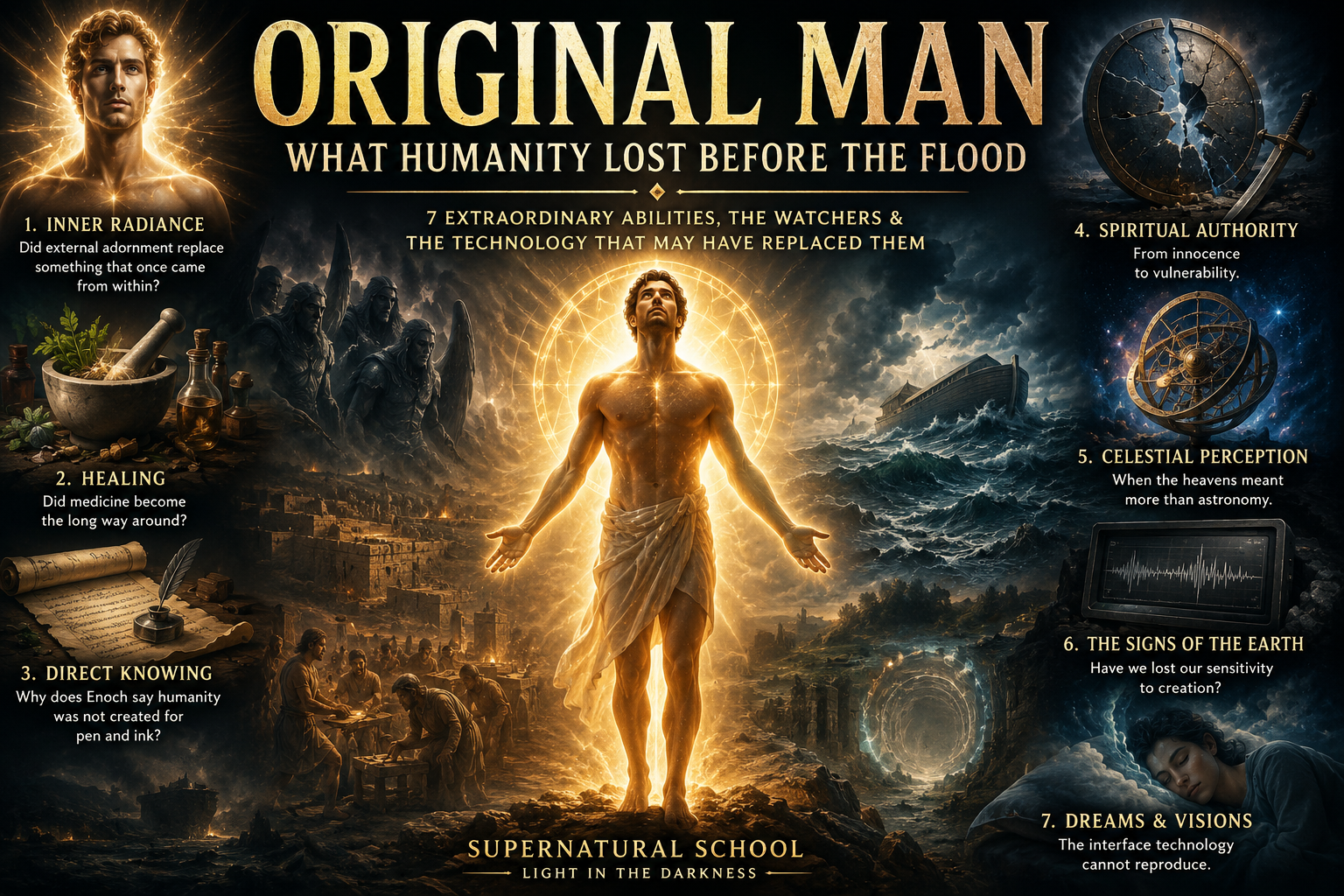
What Humanity Lost Before the Flood
Seven extraordinary abilities, the Watchers, and the technology that may have replaced them
Excerpt:
What if the story of human progress is not simply the story of gaining new abilities? What if some of our technologies imitate capacities humanity was originally intended to possess in a very different way? The Book of Enoch preserves a disturbing account of forbidden knowledge, corrupted humanity and the world before the Flood. Read alongside Genesis, it raises an extraordinary question: What was Original Man actually like?
Before Technology, There Was Man
We usually tell the story of humanity in one direction.
Primitive man became intelligent.
Ignorance became knowledge.
Weakness became technology.
The cave became the city.
The herb became the laboratory.
The naked eye became the telescope.
The spoken word became writing, libraries and eventually the internet.
According to this story, technology represents humanity climbing upward.
But the biblical account begins somewhere very different.
Man does not begin as an ignorant animal struggling upward toward consciousness. Humanity begins intentionally designed.
“So God created man in His own image...”
— Genesis 1:27, NKJV
Adam enters creation already possessing language, intelligence, relational awareness, spiritual perception, responsibility and direct fellowship with God.
He does not discover language.
He speaks.
He does not slowly become conscious of God.
He encounters Him.
He does not invent his purpose.
He receives it.
This is Original Man.
And when we turn to the ancient Book of Enoch, an intriguing possibility emerges.
Perhaps some things we call human advancement are not merely additions.
Perhaps they are also echoes.
External attempts to accomplish through tools what humanity once experienced very differently.
That is the question behind this investigation.
The Watchers and the Forbidden Transfer
Genesis 6 describes a mysterious corruption before the Flood involving the “sons of God,” human women, the Nephilim and an earth increasingly overwhelmed by violence.
Enoch dramatically expands this episode.
In its account, heavenly beings commonly called the Watchers descend and begin revealing knowledge to humanity that mankind was never supposed to receive from them.
Azazel teaches weapons and metalworking together with ornaments, antimony and the beautification of the eyes. Semjaza teaches enchantments and root-cuttings. Other Watchers teach knowledge concerning the stars, constellations, sun, moon and signs of the earth.
Later chapters associate Penemue with writing and Kasdeja with forbidden knowledge concerning spiritual attacks.
Notice something important.
The problem is not simply that humanity learned things.
The problem is the source, timing and purpose of the knowledge.
Knowledge crossed a boundary.
And humanity became corrupted by what it received.
That leads us to a remarkable question:
Did forbidden knowledge merely give humanity new abilities—or did dependence upon external knowledge also contribute to humanity forgetting something about its original design?
Enoch never directly answers that question.
But it gives us several extraordinary clues.
INNER RADIANCE
Did External Adornment Replace Something That Once Came From Within?
One of Enoch's strangest descriptions concerns the birth of Noah.
Noah's appearance terrifies his father Lamech.
His body is described as extraordinarily bright, his eyes like rays of the sun, and when he opens them the entire house appears illuminated.
Lamech becomes so disturbed by the child's appearance that he wonders whether Noah might actually be connected to heavenly beings.
Whatever we make of this passage, Enoch clearly associates unusual humanity with radiance.
Now consider what Azazel teaches.
Weapons.
Metalworking.
Ornaments.
Antimony.
The beautification of the eyes.
Colouring tinctures.
Modern readers naturally separate warfare from cosmetics.
Enoch places them within the same forbidden transfer.
Why?
Perhaps the deeper issue is not makeup itself.
Perhaps it is the transition from being to manufacturing appearance.
Biblically, humanity's glory was always derivative. Man reflected God; he was never the source of his own glory.
Sin moves humanity toward external substitutes.
We increasingly attempt to manufacture outwardly what can no longer be produced inwardly.
Original Man question:
Was humanity designed to carry an outward expression of inward glory that fallen humanity now attempts to imitate externally?
The biblical story eventually points forward to another transformation:
“Then the righteous will shine forth as the sun...”
— Matthew 13:43, NKJV
Perhaps radiance is not as foreign to biblical anthropology as modern readers assume.
HEALING
Did Medicine Become the Long Way Around?
Enoch says Semjaza taught humanity enchantments and root-cuttings.
That pairing is fascinating.
There is a physical component:
the root.
And a spiritual or verbal component:
the enchantment.
From a biblical worldview, this should not lead us toward occult practice. Scripture repeatedly prohibits sorcery.
But it reveals something important about the Watchers' knowledge.
Their worldview did not divide reality into the categories modern Western society commonly uses:
physical over here, spiritual over there.
They understood the two as interacting.
Modern medicine largely retained the material side.
Plant.
Chemical.
Compound.
Extraction.
Dosage.
We became extraordinarily skilled at manipulating matter.
But Scripture presents healing as capable of operating at another level entirely.
Jesus touched the sick.
Spoke commands.
Rebuked conditions.
Commissioned His disciples to heal.
The early Church prayed, laid hands upon the sick and expected God to act.
This does not make medicine evil.
Nor does Enoch say humanity originally possessed instantaneous biological regeneration.
That would go beyond the text.
But it raises a legitimate question.
Original Man question:
Have we become so dependent upon external intervention that we have forgotten how profoundly spiritual and physical reality were designed to interact?
Medicine may not be the enemy.
Dependence may be.
DIRECT KNOWING
Why Does Enoch Say Humanity Was Not Created for Pen and Ink?
This may be the most extraordinary passage of them all.
Enoch identifies a being named Penemue, who teaches humanity writing with ink and paper.
Then comes an astonishing statement.
Humanity, the text says, was not created to establish good faith through pen and ink.
Think about that.
Modern civilisation depends upon documentation.
Contracts.
Certificates.
Identification.
Receipts.
Records.
Signatures.
Databases.
Passwords.
Evidence.
We write things down because memory fails.
We create contracts because trust fails.
We record transactions because testimony can be disputed.
Writing is one of civilisation's greatest tools.
But what kind of humanity would require no written confirmation of good faith?
A humanity in which truth could be trusted.
A humanity in which integrity was normal.
A humanity whose internal condition matched its external word.
Perhaps the greater loss was not telepathy or supernatural information retrieval.
Perhaps it was something even more profound:
mankind once lived without the enormous infrastructure required to compensate for deception.
Jesus points toward this restored simplicity:
“But let your ‘Yes’ be ‘Yes,’ and your ‘No,’ ‘No.’”
— Matthew 5:37, NKJV
Original Man question:
Did writing become essential because fallen humanity could no longer trust memory, testimony and character?
If so, technology is compensating not merely for intellectual limitation—
but for moral collapse.
SPIRITUAL AUTHORITY
From Innocence to Vulnerability
Enoch attributes another disturbing body of knowledge to Kasdeja.
He reveals various “smitings” associated with spirits and demons, attacks concerning the unborn, the soul, serpentine harm and destructive effects associated with noonday heat.
The important point is not that humanity possessed some forgotten magical combat technique.
The text says humanity was shown vulnerabilities.
That distinction matters.
Before the Fall, Adam's relationship to creation is one of delegated government.
After the Fall, humanity increasingly experiences creation as hostile territory.
Something fundamental has changed.
Yet the New Testament introduces another Man.
Jesus.
Where others are tormented by demons, Christ commands them.
Where storms terrify men, Christ speaks to the storm.
Where disease rules bodies, Christ heals.
Where death appears final, Christ raises the dead.
Jesus does not behave like fallen humanity desperately attempting to negotiate with darkness.
He behaves as One possessing authority.
And then He delegates authority to His disciples.
“Behold, I give you the authority...”
— Luke 10:19, NKJV
This is where Original Man becomes far more than an investigation of the past.
Jesus reveals what humanity under God's government looks like.
Original Man question:
Are some of the things we consider supernatural actually glimpses of humanity functioning again under its proper King?
CELESTIAL PERCEPTION
When the Heavens Meant More Than Astronomy
Enoch names several Watchers associated with celestial knowledge.
Baraqijal teaches astrology.
Kokabel, the constellations.
Shamsiel, signs of the sun.
Sariel, the course of the moon.
Araqiel, signs of the earth.
This should immediately raise a biblical distinction.
The Bible condemns divination and astrology as methods of obtaining guidance apart from God.
But Scripture simultaneously presents the heavens as meaningful.
“The heavens declare the glory of God...”
— Psalm 19:1, NKJV
The Magi recognise a celestial sign associated with Christ's birth.
Joel speaks of signs in the heavens.
Jesus speaks of celestial signs.
Revelation is filled with cosmic imagery.
The heavens are not gods.
They are creation.
They do not govern God's people.
God governs them.
Yet biblical humanity appears much more comfortable with the idea that creation communicates something about its Creator than modern secular humanity does.
Today we possess instruments of extraordinary power.
Telescopes see farther than any ancient human could.
Satellites measure phenomena invisible to our eyes.
Yet technological sight does not necessarily produce spiritual perception.
We have increased our ability to see the heavens while decreasing our ability to understand what creation is saying about God.
That may be one of the strangest paradoxes of technological civilisation.
Original Man question:
Did humanity gain better instruments while losing a worldview capable of interpreting creation correctly?
THE SIGNS OF THE EARTH
Have We Lost Our Sensitivity to Creation?
Enoch says Araqiel taught humanity the signs of the earth.
It is tempting to jump immediately from this statement to claims about supernatural earthquake prediction.
We should be careful.
Enoch does not explicitly say humanity once possessed an internal earthquake sensor.
But the phrase still opens an intriguing line of thought.
Animals respond to environmental signals humans frequently overlook.
Changes in vibration.
Pressure.
Sound.
Magnetic fields.
Weather.
Chemical signals.
Human technology increasingly detects these things through machines.
Seismometers.
Satellites.
Weather stations.
Sensors.
Radar.
GPS.
Again we encounter the same pattern.
We are extraordinarily good at building external senses.
A telescope is an external eye.
A microphone is an external ear.
A seismometer is an external sensitivity to movement.
A computer becomes external memory.
Artificial intelligence increasingly becomes externalised analysis.
Technology extends us.
But extension raises another question.
What happens when an extension becomes a replacement?
The biblical person was never intended to live disconnected from creation.
Adam was formed from the ground.
He tended the garden.
He named animals.
He recognised seasons.
He lived within creation rather than observing it almost entirely through screens.
Original Man question:
As our technological senses grow stronger, are our natural sensitivities becoming weaker?
7. DREAMS AND VISIONS
The Interface Technology Cannot Reproduce
Here we need to make an important correction to the more speculative versions of the “Hard Reset” theory.
Dreams are not the only remaining biblical interface between the human and spiritual worlds.
Scripture includes:
dreams,
visions,
prophecy,
angelic appearances,
the gifts of the Holy Spirit,
prayer,
spiritual discernment,
and most importantly the indwelling presence of the Holy Spirit.
Nevertheless, dreams remain remarkable.
For several hours every night the body becomes almost motionless while the human mind enters experiences that can contain imagery, emotion, memory and occasionally—according to Scripture—genuine revelation.
Joseph dreams.
Jacob dreams.
Daniel receives dreams and visions.
Joseph, husband of Mary, receives divine instruction through dreams.
Peter quotes Joel concerning dreams and visions in connection with the outpouring of the Spirit.
Technology can imitate an image.
Virtual reality can imitate an environment.
Artificial intelligence can generate worlds.
But none of these technologies explains why God repeatedly chose the sleeping human mind as one way of communicating.
Original Man question:
Are dreams a reminder that human consciousness was designed to interact with more than the material world?
I believe the biblical answer is yes.
Man is not simply biological machinery.
THE “HARD RESET”
This is where the original title still belongs.
Not as the identity of the entire teaching—
but as one moment within it.
The Flood can be viewed metaphorically as a hard reset.
Genesis describes an earth corrupted and filled with violence.
Enoch expands that picture into a civilisation contaminated by rebellion, forbidden knowledge and illegitimate spiritual intervention.
Then judgment comes.
The old world disappears beneath the water.
Noah emerges on the other side.
But humanity does not return to Eden.
Something has been preserved—
yet something has clearly been lost.
Lifespans eventually decrease dramatically.
Human civilisation rebuilds.
Languages divide.
Kingdoms rise.
Tools multiply.
And mankind begins the long technological journey toward extending its abilities once again.
TECHNOLOGY: ENEMY OR PROSTHETIC?
The conclusion should not be:
Technology is evil.
That would be far too simple.
Noah builds an ark.
Bezalel is supernaturally empowered by the Spirit of God in craftsmanship.
Solomon builds.
Luke practices medicine.
Paul writes letters.
Technology can serve righteousness.
The more interesting question is:
What happens when a tool designed to serve humanity begins defining humanity?
Glasses compensate for sight.
Cars compensate for distance.
Phones compensate for separation.
Databases compensate for memory.
Medicine compensates for physical weakness.
Satellites compensate for limited perception.
Artificial intelligence increasingly compensates for intellectual labour.
There is nothing inherently sinful about compensation.
But a prosthetic becomes dangerous when its wearer forgets that it is a prosthetic.
Technology can increase human capability while simultaneously decreasing human development.
GPS can strengthen navigation while weakening our internal sense of direction.
Search engines increase access to information while reducing the need to remember it.
Social media connects enormous populations while sometimes weakening face-to-face community.
AI can expand our intellectual reach while tempting us to stop thinking.
The issue is not merely what technology can do.
The issue is:
What is technology training humanity to no longer do?
That may be the question Enoch unexpectedly forces upon the modern world.
ORIGINAL MAN WAS NEVER SUPPOSED TO LIVE INDEPENDENTLY
There is one final correction we must make.
The goal is not to recover some mythical superhuman Adam independently of God.
That would repeat the original temptation.
“You will be like God...”
— Genesis 3:5, NKJV
Original Man's power was never independence.
His strength was alignment.
God was above him.
Creation was beneath his stewardship.
His spirit, soul and body functioned under divine order.
Authority flowed from relationship.
Knowledge came from the correct Source.
Identity preceded assignment.
And everything functioned because mankind remained connected to God.
Therefore the biblical answer to humanity's lost condition is not:
Become ancient man again.
It is:
Become new in Christ.
JESUS AND THE RESTORATION OF MAN
This is where the investigation becomes much larger than Enoch.
Jesus is called the last Adam.
“The first man Adam became a living being. The last Adam became a life-giving spirit.”
— 1 Corinthians 15:45, NKJV
Christ does not merely rescue fallen human beings from punishment.
He begins a new humanity.
The believer is described as:
a new creation,
born of the Spirit,
seated with Christ,
indwelt by the Holy Spirit,
given spiritual gifts,
given authority over the enemy,
being transformed into Christ's image,
and ultimately destined for bodily resurrection.
The Christian story therefore does not end with Lost Man.
It moves:
ORIGINAL MAN
Created in God's image.
↓
FALLEN MAN
Separated, corrupted and diminished.
↓
REDEEMED MAN
Reconciled to God through Jesus Christ.
↓
NEW CREATION
Indwelt by the Spirit and being restored into the image of Christ.
↓
GLORIFIED MAN
Resurrection. Incorruption. Immortality.
Technology cannot accomplish that.
No machine can resurrect a man.
No algorithm can produce holiness.
No cosmetic can manufacture glory.
No database can create truth.
No telescope can reveal God to a heart determined not to see Him.
No medicine can produce eternal life.
And no artificial intelligence can reproduce the image of God.
THE REAL QUESTION
Perhaps we have been asking the wrong question.
Instead of asking:
“What new powers can humanity acquire?”
we should ask:
“What was humanity originally designed to become?”
And then an even greater question:
“What has Jesus Christ already begun restoring?”
That investigation takes us far beyond the Book of Enoch.
It takes us from Genesis—
through the Fall—
through the Watchers—
through the Flood—
to Bethlehem,
the Cross,
the empty tomb,
Pentecost,
and ultimately resurrection.
Maybe humanity's greatest future is not technological.
Maybe it is restorational.
Not mankind becoming gods.
But mankind finally becoming what God intended mankind to be.
Reflection
Consider the technologies you use every day.
Which ones genuinely extend your abilities?
Which ones have begun replacing abilities you no longer practise?
Where have convenience and dependence become difficult to distinguish?
Most importantly:
What aspects of human life can only be restored through relationship with God rather than technological advancement?
Activation
Take seven days and deliberately exercise one God-given human capacity without immediately outsourcing it to technology.
Remember something instead of searching for it.
Navigate somewhere familiar without GPS.
Spend time observing creation without a screen.
Pray before searching for answers.
Write down a dream before reaching for your phone.
Sit silently before God and practise listening.
Read Scripture and wrestle with the passage before consulting commentary.
The objective is not to reject technology.
It is to put technology back into its proper position:
servant, not master.
A Note on the Book of Enoch
1 Enoch is an ancient Jewish work that deeply influenced the world surrounding early Judaism and Christianity. The New Testament book of Jude contains language closely corresponding to 1 Enoch 1:9, and Enochic traditions were known among early Christians. The complete text survived principally through the Ge'ez manuscript tradition and continues to hold scriptural status within the Ethiopian Orthodox Tewahedo tradition. Complete manuscripts were brought back to Western Europe by James Bruce in 1773, with the first English translation appearing in 1821—so it is more accurate to speak of Enoch's Western recovery beginning in the eighteenth century rather than the early twentieth century.
This article distinguishes between what 1 Enoch explicitly says and the interpretive “Original Man” hypothesis developed from those passages. Enoch explicitly describes forbidden knowledge being transmitted to humanity; it does not explicitly teach that each technology replaced a corresponding biological superpower. That question is explored here as a theological and philosophical possibility rather than stated as established doctrine.
For Christian doctrine, Scripture remains the governing authority.
Scripture Trail
Genesis 1:26–28
Genesis 2:7–25
Genesis 3
Genesis 6:1–13
Psalm 19:1–4
Matthew 10:1
Luke 10:19
Acts 2:16–18
1 Corinthians 15:42–49
2 Corinthians 5:17
Ephesians 1:19–23
Ephesians 2:4–6
Jude 14–15
Revelation 21–22
Enoch references:
1 Enoch 8
1 Enoch 69
1 Enoch 106