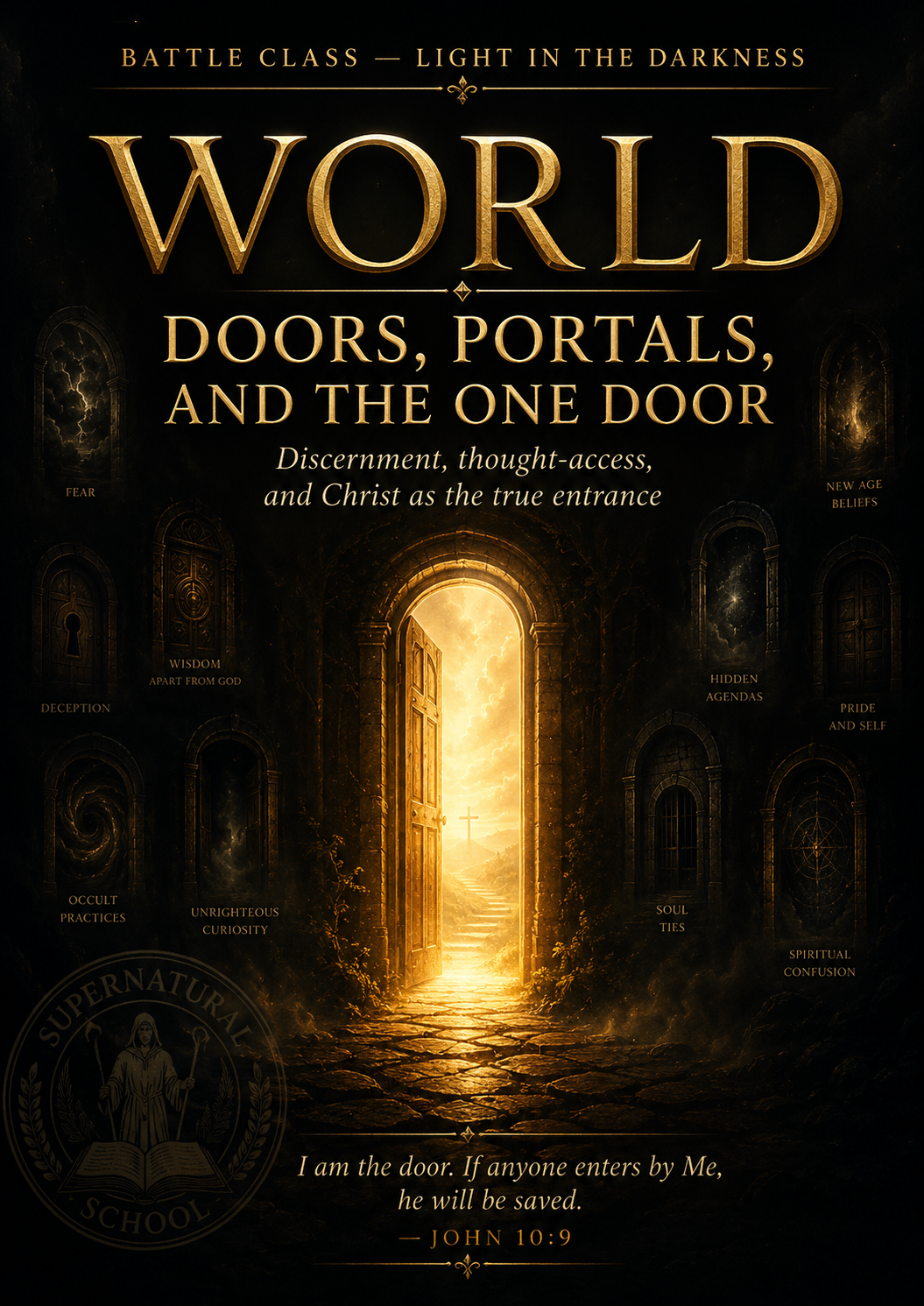
World: Doors, Portals, and the One Door
How Scripture Exposes Thought-Portals and Reveals Christ as the True Entrance
There are doors everywhere.
Some are visible.
Some are hidden.
Some appear as opportunities.
Some arrive as ideas.
Some enter through fear, curiosity, ambition, pain, pride, or desire.
Every door offers access.
But not every door leads to life.
The world teaches us that all doors are equal, all paths are valid, and every spiritual entrance eventually leads to the same place.
Scripture says otherwise.
There are many doors, but there is only one Door.
And that Door is not a method, a ritual, an idea, or a spiritual technique.
The Door is a Person.
Jesus Christ.
“I am the door. If anyone enters by Me, he will be saved, and will go in and out and find pasture.”
— John 10:9, NKJV
Two Orders: Heavenly and Earthly
The Bible reveals two governing directions.
There is what is above, and there is what is earthly.
There is what comes from God, and there is what emerges from fallen human desire, spiritual deception, pride, fear, and self-rule.
Paul writes:
“If then you were raised with Christ, seek those things which are above, where Christ is, sitting at the right hand of God. Set your mind on things above, not on things on the earth.”
— Colossians 3:1–2, NKJV
This is not a rejection of the physical world.
It is a warning about government.
What governs your thinking?
What governs your imagination?
What governs your desires?
What governs your decisions?
The heavenly order is governed by Christ.
The earthly order is governed by what can be seen, felt, feared, desired, controlled, or possessed apart from Him.
The issue is not whether something appears spiritual.
Many things appear spiritual.
The real question is:
What is its source?
What fruit does it produce?
Where does it lead?
Not everything that opens the imagination opens the way to God.
What Is a Thought-Portal?
The word portal can become sensational when it is separated from Scripture.
But in simple terms, a portal is a point of access.
A thought can become a point of access.
An idea can become a point of access.
A repeated fear can become a point of access.
A desire can become a point of access.
A teaching, image, relationship, wound, memory, philosophy, or spiritual practice can become an entrance through which influence is welcomed.
A doorway does not force a person to enter.
It presents access.
In the same way, thoughts present invitations.
A thought may appear harmless at first, but once it is welcomed, repeated, believed, and obeyed, it can begin to shape identity, direction, loyalty, and action.
That is why Scripture commands us to take thoughts seriously.
*“For the weapons of our warfare are not carnal but mighty in God for pulling down strongholds, casting down arguments and every high thing that