

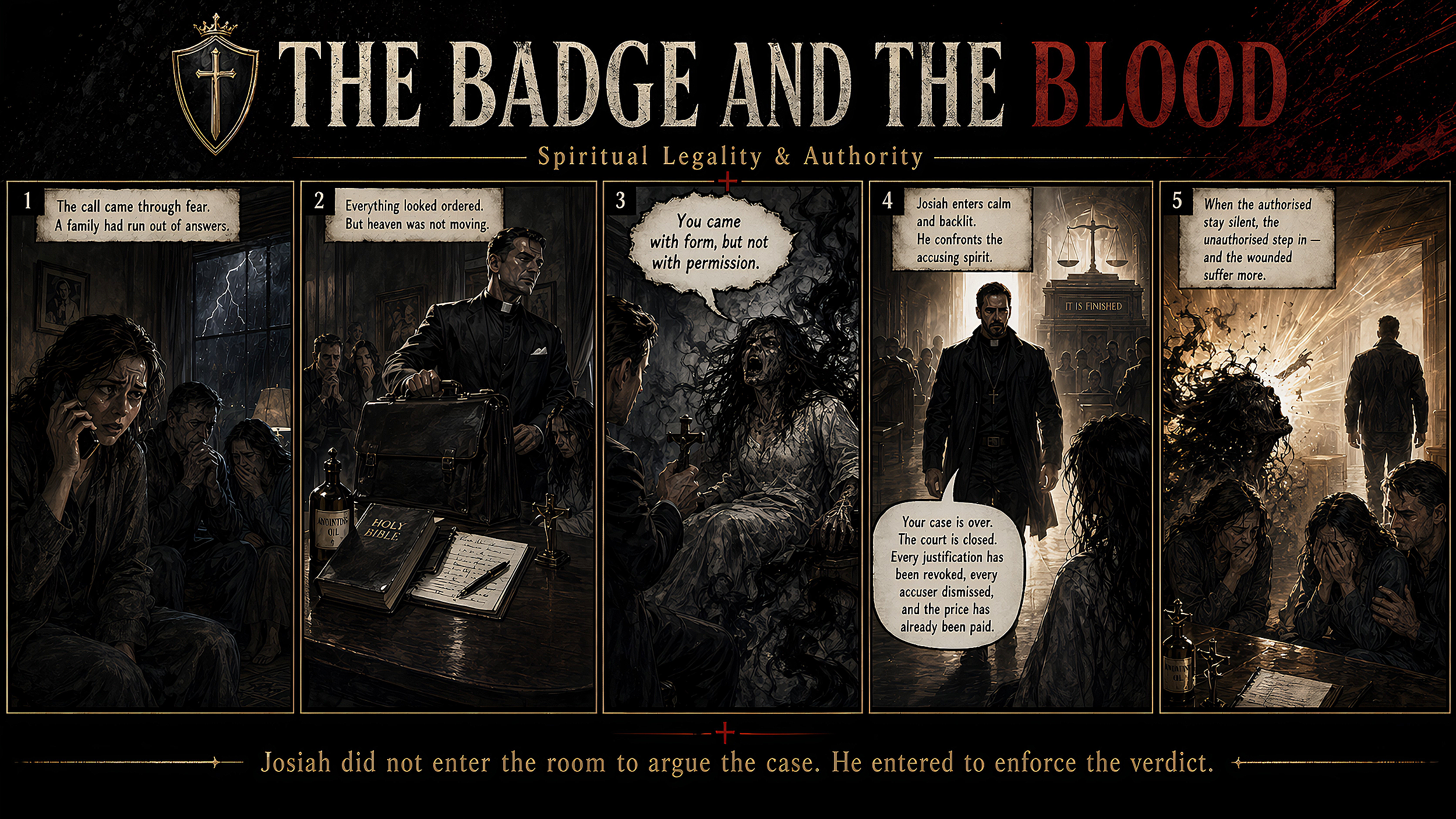
The Badge and the Blood
The call came just after midnight.
Not through church channels.
Not through a ministry office.
Not through some carefully built network.
It came through fear.
A young woman named Eliana had not slept in days. Her family said something had changed. Her voice shifted at night. She knew things she should not know. At the mention of prayer, she became agitated. At the reading of Scripture, she would scream or laugh in a way that chilled everyone in the room.
The family had done what most people do when fear takes over.
They called for help.
The first to arrive was a professional priest.
He came prepared.
Measured voice. Religious garments. Leather case. Procedure. Language. Reputation. Oils. Notes. Sacred objects. Everything about him looked ordered. He carried himself like a man who knew how to appear in control.
He entered the room and began to arrange the atmosphere.
He placed his items carefully.
He instructed the family where to stand.
He began to speak in a steady, practised tone.
Everything looked proper.
But heaven was not moving.
Because there is a difference between handling sacred things and standing under sacred authority.
At first Eliana sat quietly.
Then her head lifted.
Her eyes fixed on him.
And something behind her voice answered.
“You came with form,” it said, “but not with permission.”
The room turned cold.
The priest stiffened but continued.
He raised his voice.
He repeated his phrases.
He reached for more procedure, more language, more visible effort.
But the thing did not yield.
It resisted him.
The harder he tried to regain control, the more exposed he became. He had appearance, training, and office, but he did not carry government. He knew the language of sacred things, but he was not standing in the weight of spiritual authority.
He wore the badge.
He did not carry the blood.
Then another man entered.
No title.
No theatre.
No professional aura.
His name was Josiah.
He looked ordinary to the natural eye.
No display. No performance. No attempt to impress the room.
But the moment he entered, something changed.
Not because he was loud.
Because he was settled.
He did not rush toward the problem.
He did not study the darkness with fear.
He did not compete with the priest.
He stood still.
And in that stillness, government entered the room.
The professional priest turned toward him and whispered, “This is highly complex.”
Josiah did not answer him.
He stepped forward and looked at Eliana, but deeper than Eliana. He recognised the matter for what it was.
Not mystery.
Not equality.
Trespass.
Then the accusing spirit spoke again, louder than before. It spoke of old agreements. It spoke of family weakness. It spoke of fear, history, and vulnerability. It built its case like an accuser in a courtroom.
Josiah let it speak only long enough for its fraud to be seen.
Then he answered like a man enforcing a verdict.
“Your case is over. The court is closed. Every justification has been revoked, every accuser dismissed, and the price has already been paid.”
The room went still.
No strain.
No theatre.
No ritual dependency.
He stepped forward.
“Eliana belongs to Jesus Christ. You have no right to remain. Leave her now.”
What followed was sudden and violent, then final.
Eliana fell forward.
A cry came out of her that was not hers.
Then silence.
Not empty silence.
Clean silence.
The kind of silence that comes when an illegal occupant has been expelled.
Eliana began to weep.
Her mother sank to her knees in relief.
Her brother stood trembling, overwhelmed by what he had just witnessed.
The room felt different now. Clearer. Lighter.
The professional priest said nothing.
Because in one moment, the difference had been exposed.
One man came with worldly method clothed in religious form.
The other came as an authorised believer under the rule of Christ.
One tried to manage darkness.
The other enforced a finished verdict.
One leaned on procedure.
The other stood in covenant.
Before leaving, Josiah spoke to the family.
“Do not admire freedom and then neglect truth. Fill this house with the Word. Fill your life with obedience. Do not wait for crisis to take your place in Christ seriously.”
Then he turned toward the priest.
His words were not cruel.
But they were sharp.
“When the authorised stay silent, the unauthorised step in. And the wounded suffer more.”
Then he left as quietly as he came.
No performance.
No claim of greatness.
Only the evidence that true authority does not need spectacle.
Josiah did not enter the room to argue the case.
He entered to enforce the verdict.
What this story reveals
This story is not mainly about dramatic confrontation.
It is about authorisation.
The central issue is not whether someone uses religious language.
The issue is whether they stand in the reality they are speaking about.
1. Form is not the same as government
A person may have:
religious vocabulary
visible office
ceremonial confidence
ministry appearance
years of outward practice
And still not be standing in true authority.
The priest in the story had form.
What he lacked was government.
2. Spiritual conflict is not solved by worldly method
When spiritual matters are handled through image, procedure, or technique alone, things often become worse. What is needed is not merely a method but standing.
Josiah did not enter the room to create an atmosphere.
He entered as a man who knew the case was already settled in Christ.
3. The sons of Sceva still speak today
Acts 19 is not just an old story.
It is a warning.
The sons of Sceva represent a continuing danger: using the right words without the right standing. Speaking of authority without living under it. Trying to confront spiritual realities through borrowed language.
That danger still exists now.
4. The believer in Christ is not called to passive observation
One of the strongest lessons in this story is the charge at the end:
When the authorised stay silent, the unauthorised step in.
This is where many problems grow.
When true believers withdraw:
the counterfeit fills the space
fear grows
the wounded are mishandled
spiritual confusion deepens
The answer is not pride.
It is not self-promotion.
It is faithful, submitted, authorised engagement.
5. Spiritual legality matters
The language of this story is intentionally legal.
Why?
Because the work of Christ is not vague. It is decisive.
The believer does not approach darkness as though the outcome is uncertain. In Christ:
the case has been answered
the claim has been broken
the accuser has been overruled
the price has been paid
This is why Josiah speaks like an enforcer, not a negotiator.
Scripture anchors
This story is best read alongside these passages:
Acts 19:13–16 — the sons of Sceva and unauthorised spiritual confrontation
Luke 10:19 — authority over the power of the enemy
Mark 16:17 — in My name they will cast out demons
Colossians 2:15 — Christ disarmed principalities and powers
Hebrews 7 — priesthood after the order of Melchizedek
James 4:7 — submit to God, resist the devil, and he will flee
Battle Class takeaway
The authorised believer does not negotiate with a broken claim.
He does not enter the room to admire the crisis.
He does not enter to imitate spiritual authority.
He does not enter to manage darkness through image.
He enters to enforce the verdict of Christ.
Josiah did not enter the room to argue the case. He entered to enforce the verdict.
Closing charge
This is the warning.
The world is full of professionals.
The Church is meant to be full of authorised believers.
If the authorised remain passive, the unauthorised will continue to step into matters they cannot finish. And often, the wounded will pay the price.
So the call is simple:
Grow in truth.
Stand in Christ.
Know the difference between performance and authority.
Do not leave the field empty for the counterfeit.
Call to action
If this resonates with you, Battle Class exists to help believers think clearly, stand firmly, and engage faithfully from a biblical worldview.
Battle Class is not about spectacle.
It is about formation, discernment, and government.
If you want to grow in spiritual clarity, authority, and purpose, this is the kind of training we are building.
The court is closed. The verdict stands. The authorised must engage.