

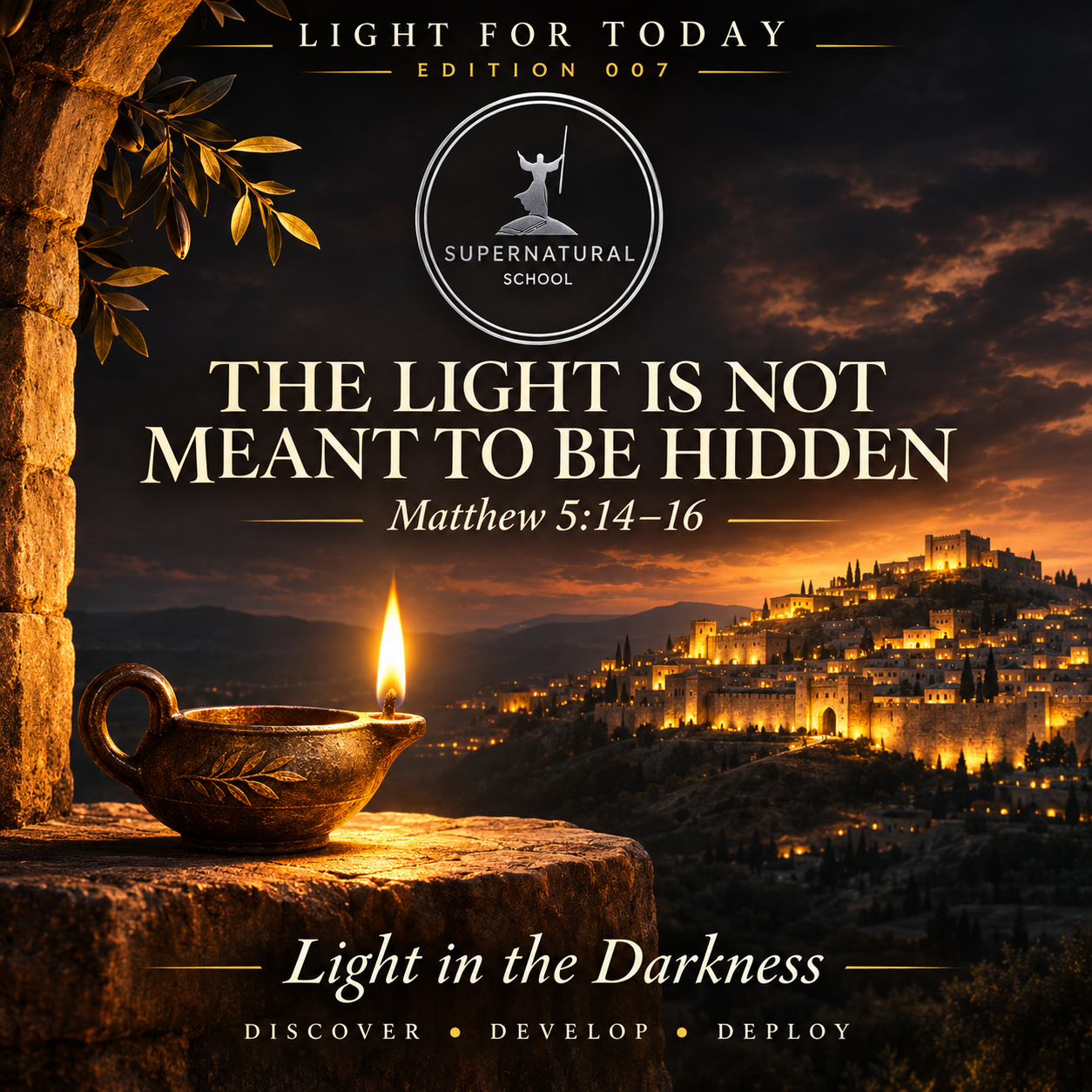
Light for Today — Edition 007 | Extended Teaching
Supernatural School — Light in the Darkness
Foundational Scripture: Matthew 5:14–16 (NKJV)
Introduction: Why Did Jesus Call Us Light?
Jesus begins with identity before instruction.
In Matthew 5:14, He says:
“You are the light of the world.” (NKJV)
Then He describes a city on a hill and a lamp placed where it can illuminate a home.
He does not call His disciples to promote themselves. He calls them to live in a way that directs attention to the Father.
The question is not merely whether others notice us, but whether our conduct helps them recognise God's goodness.
1. Identity Comes Before Responsibility
Jesus first names what His disciples are and then teaches them how their lives should shine.
Ephesians 5:8 follows a similar pattern: in the Lord, believers have a new identity, and they are called to walk accordingly.
We do not earn identity through performance.
Our standing in Christ is the foundation from which spiritual maturity develops.
A mature disciple learns to bring conduct, character and decisions into agreement with the truth of God's Word.
Battle Class Principle:
You do not fight to become light. You learn to stand and walk according to your identity in Christ.
2. Light Is Not Defined by Darkness
The presence of a dark environment does not alter the purpose of a lamp.
Similarly, difficulty or opposition need not determine how a Christian responds.
Yet this illustration has a limit: believers do not generate spiritual light independently.
In John 8:12, Jesus identifies Himself as the light of the world.
John 1:5 describes the light shining in darkness in the context of Christ.
Our witness flows from Him.
Christ is the source. We are His witnesses.
Confidence in Christian discipleship is therefore rooted in Christ, not in a claim of self-sufficient power.
3. A City on a Hill Cannot Be Hidden
An elevated city is naturally visible.
Jesus uses the image to show that discipleship has public consequences.
Christian faith should influence life outside a meeting, classroom or church service.
An employer can lead with fairness.
A parent can respond with patience.
A student can act honestly.
A neighbour can show practical compassion.
These are not dramatic performances, but they can point people toward the character of God.
The visibility Jesus describes is not necessarily the visibility of a platform. It is the visibility of a life shaped by His teaching.
4. Why Would Someone Hide a Lamp?
Jesus' lamp illustration in Matthew 5:15 asks us to consider whether we hide our witness through fear, uncertainty, passivity or the belief that only extraordinary actions matter.
The point is not that every believer must seek public attention.
In Matthew 6:1, Jesus warns against displaying righteous acts merely to be noticed.
Wise witness can include quiet service and private faithfulness.
Being visible for God's glory is different from seeking visibility for ourselves.
5. The Purpose of the Light Is to Reveal the Father
Matthew 5:16 explains the destination of a disciple's good works:
The Father receives glory.
This gives us a test for ministry, leadership, outreach and communication.
When we teach, are people encouraged to trust Christ?
When we help, do our actions make the Father's goodness more understandable?
When we share stories, do we point beyond ourselves?
Excellent teaching, storytelling, design and service are valuable.
But they serve the greater purpose of revealing God's truth and goodness.
The purpose of the light is not to draw attention to the lamp, but to reveal the Father.
6. Discover • Develop • Deploy
DISCOVER — Know Who You Are
Read Matthew 5:14 and Ephesians 5:8.
Ask yourself:
Am I interpreting my identity from Scripture or from my circumstances?
DEVELOP — Learn to Walk Consistently
Read Matthew 5:15 and Galatians 5:22–23.
Ask yourself:
What response, attitude or habit needs to reflect Christ more clearly?
DEPLOY — Let the Light Serve Others
Read Matthew 5:16.
Ask yourself:
Who might encounter the goodness of God through my actions this week?
Identity is discovered.
Maturity is developed.
Purpose is expressed.
All three remain dependent upon Christ.
7. Five Minutes Before Deployment
Spend five minutes reflecting on Matthew 5:14–16.
Write short answers to these questions:
Discover: What does Jesus say about my identity as His disciple?
Develop: What response or attitude needs to agree with that identity today?
Deploy: What practical act of goodness could point someone toward the Father?
Choose one action to practise today.
The goal is not another religious performance.
It is faithful living from a growing understanding of Christ.
Closing Declaration
I am not called to become consumed by the darkness around me.
I am called to know Christ.
I am called to understand who I am in Him.
I am called to develop in wisdom and character.
I am called to serve others faithfully.
THE LIGHT IS NOT MEANT TO BE HIDDEN.
AND THE GLORY BELONGS TO THE FATHER.
Closing Prayer
Father,
Thank You for revealing Jesus as the light of the world.
Help me understand what it means to belong to Him and to live according to Your Word.
Let my conduct reflect Your goodness, my words communicate Your truth and my actions demonstrate Your love.
Keep me from seeking recognition for myself.
May people see beyond my life and discover You.
In Jesus' name,
Amen.
Scripture References (NKJV):
Matthew 5:14–16; John 8:12; John 1:5; Ephesians 5:8–10; Matthew 6:1; Galatians 5:22–23.
Supernatural School — Light in the Darkness
Discover • Develop • Deploy